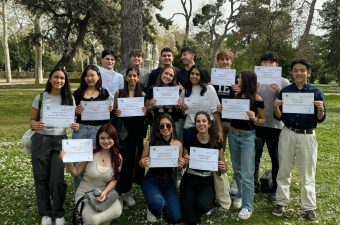
In today’s globalized economic context, future graduates need to prepare for life as effective leaders on the world stage—and it’s the responsibility of institutions of higher education to make sure that happens. At IE University, we work hard to develop dynamic learning approaches to provide talented individuals with the insights and resources to effect lasting change.
In all our law programs, our world-class faculty go beyond the confines of any single legal system to mirror the reality of international law. This high-impact methodology allows students to interact with the current trends, insights, and challenges present in key international legal jurisdictions to develop a wholly global outlook.
The current global context calls for inspirational professors to train lawyers of international renown. Below, we get the opportunity to hear from one of them.

Michail Risvas is currently an Assistant Professor in Public International Law at IE University, an area he specializes in alongside International Arbitration and WTO law. He has both carried out research and taught in Public International Law at the University of Oxford and the University of Amsterdam. As well as this, he also has a wide range of publications on international economic law, the law of the sea, cultural heritage, and terrorism. Used to working across cultures, Michail speaks four languages and holds a doctorate on non-discrimination in international economic law from the University of Oxford.
After studying and researching in Lyon, Athens, Amsterdam, and Oxford, he then spent four years as an associate at a firm in Paris. Here, he acted as counsel in investment and commercial arbitrations under the ICSID, UNCITRAL, LCIA, and ICC rules in a number of sectors including banking, defense, gaming, mining, and metallurgy. With this extensive and dynamic background across various countries, Michail brings his vast knowledge, holistic perspectives, and engaging teaching style to his role at IE University.
We spoke with him to find out how he applies his unique perspective on law to the courses he teaches.
What courses do you teach at IE University?
I currently teach Public International Law and Administrative Law at the undergraduate level and International Arbitration at the master’s level.
How do you approach the methodology of comparative law in your course?
I employ a comparative law methodology in all the courses I teach. For example, in Public International Law, I examine the relationship between international law and domestic law in different jurisdictions, through students’ assignments. The administrative law course is essentially a comparative administrative law course, focusing mainly but not exclusively in the UK, USA, France, Germany, and Spain, as well as on case studies.
What is, in your opinion, the added value of teaching with the comparative law methodology in an international environment?
The comparative methodology is an invaluable tool that enhances the students’ understanding and better prepares them for the global legal market.
How would you define an IE University law graduate? And how does the methodology of comparative law contribute to this profile?
IE University is unique in its emphasis on comparative law methodology across all undergraduate courses. This fits with the highly international character of the student body and, building on the students’ international profile, prepares young legal professionals very well for international legal careers.

It’s Professor Risvas’ dynamic, global perspective that makes him a perfect fit at IE University. Educators like him prepare students to graduate and enter the legal industry ready to tackle the challenges of the modern world of law head-on.