How cities will change to accommodate sustainability?
Associate Dean of IE School of Architecture and Design Cristina Mateo has several decades of experience in both academia and the professional realm. With journalism training, a PhD in Sociology and an Executive MBA in E-business from IE Business School, Professor Mateo is an expert in ethnology, branding and communication, making her well-positioned to comment on urbanisation and what we can expect our cities to look like in the years and decades to come.
Professor Mateo recently shared her thoughts on what we can do to make our cities more sustainable and the types of changes the future will bring in terms of lifestyle and organization. Based on a three-pronged approach that considers the social, environmental, and economic aspects of sustainability, Professor Mateo highlighted five key characteristics that make a city sustainable.


1) Ownership to Accessibility
The first of these characteristics involves relinquishing the idea of ownership in favor of greater accessibility to a greater range of services. For example, rather than individual car ownership, ride-sharing can become standard, and shared public transportation can be made more efficient, widespread and usable.
2) The 15-minute city
The second characteristic relates to creating an urban landscape in which the main things residents want to access are nearby, meaning within a 15-minute walk or bike ride. Sites like grocery stores or markets, schools and healthcare facilities can be integrated with residential neighborhoods to maximize efficiency and accessibility, and minimize the resources needed to go from A to B.
3) Availability of Third Spaces
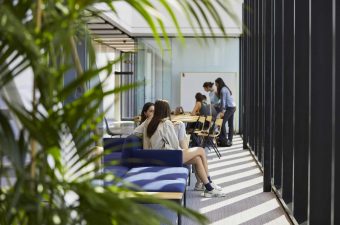
Professor Mateo underlines the importance of so-called “third spaces,” or spaces for socializing and interaction outside of the professional context and outside of the private home. The relevance of these spaces became especially apparent during the COVID-19 pandemic, and such spaces can allow us to spend time together either virtually or physically.
4) Retrofitting versus Building Anew
Given that many spaces will become obsolete as cities continue to modernize and become more sustainable, Professor Mateo notes that these sites should be revitalized by transforming them into spaces that can add value to the urban cityscape. An example of this would be turning a redundant parking lot—following the transition away from private transport—into a city garden.
5) Networks and the Internet of Things
Cities should strive to become more connected in order to share knowledge and resources. Professor Mateo cites the example of C40, a global network aimed toward urban action against climate change, as something that can produce a meaningful impact through borderless cooperation. Smaller-scale, bottom-up neighborhood initiatives could also coordinate meals for those in need.
Sustainability is a major consideration for all nations and cities moving forward, and understanding what types of behaviors to adopt and how urban landscapes need to change to meet climate goals is key to making the transition toward sustainability successful. Every citizen can be an agent of change toward a better future.
Can you envision the cities of tomorrow? The Bachelor in Urban Studies is for you.