What is the European Human Rights Moot Court?
The European Human Rights Moot Court Competition offers European law school students the opportunity to experience the inner workings of the European Court of Human Rights. Moot courts in general, are extracurricular activities where law students gain specific, hands-on experience with oral argumentation and in drafting memoranda.
As opposed to a mock trial, a moot court simulates an appellate court or arbitral case rather than a trial by jury. The European Human Rights Moot Court Competition simulates procedures specific to the European Convention on Human Rights.
This competition is organized each year by the European Law Students Association (ELSA) and the Council of Europe in order to give law students practical, first-hand experience—comparable to real procedures—pleading their case in front of the European Court of Human Rights in the final round. They are able to meet and network with other participants and judges from all over Europe.

How does the European Human Rights Moot Court Competition work?
Participants are presented with a hypothetical case to study by the European Court of Human Rights. Teams compete by first drafting two written submissions, one from the applicant and one from the respondent, in order to earn a spot in the final round of the competition. In the final round, which takes place at the European Court of Human Rights in Strasbourg, France, the best teams present their oral arguments in English to the judges.
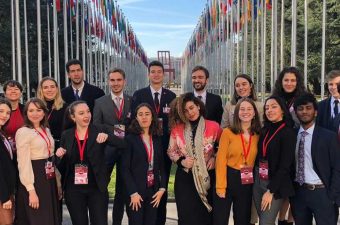
This year, students were challenged to a hypothetical case about the right to the freedom of religion. Nineteen teams, including the IE University team representing Spain, represented 14 different countries including Albania, Bulgaria, Croatia, the Czech Republic, France, Germany, Greece, Romania, Russia, (Spain), Sweden, Turkey, Ukraine and the United Kingdom in the final round.
Every qualifying team was given the chance to plead their case. The teams that were selected to move on continued to make their arguments in the quarter finals (with eight teams), semi-finals (with four teams) and the grand finale (the remaining two best teams).

Students’ experience
This year the final pleading took place on May 4 in front of prominent judges from the European Court of Human Rights and senior officials from the Council of Europe. IE University’s team of four, including Aida Fernandez, Marie Trapet, Luis Moyano and Marit Thomasdotter, guided by professors Amaya Úbeda and Maria Diaz, placed first in front of King’s College London, and City University London who came in second and third places respectively.
Professor Amaya Úbeda explains that students need to have a mix of three essential qualities in order to do well in a moot trial, “good preparation and work, passion and a team spirit.” The team worked continuously over seven months (from the initial written submission in November to the final oral pleading in May) in order to secure their win.
Luis notes that the competition, “requires a lot of precision and individual studying, as you usually study a new field of law. The judges will question your weakest points and you need to be prepared to handle these.”
Aida adds, “The key takeaway for me was teamwork. The understanding that without everyone’s work and constant dedication we would have never gotten this far. It is truly important to trust your team and understand that they will all do their part of the job and work their best, as we all have the same common goal.”
IE University students were able to experience what it is like to develop a case, facing the challenges practicing human rights lawyers encounter while preparing for and pleading their case in the European Court of Human Rights. Their win awarded each IE University student a traineeship at the European Court of Human Rights.