
At some point during your degree, the question shows up, sometimes quietly, sometimes all at once. What am I actually going to do with this?
If you are studying the humanities, you have probably heard the familiar options. Communications. Marketing. Academia. Maybe consulting. But there is a whole set of careers that rarely get named, roles where writing, research, and critical thinking directly shape social change.
One of those careers is grant writing.
Careers in context: inside a real-world impact career
In the latest Careers in Context session, students from the IE School of Humanities Professional Development Program spoke with Emily Derrick, Federal Grants and Projects Strategist at the Encore Institute for Social Impact, to understand what this work actually looks like in practice.
Here are some of the key takeaways from that conversation.
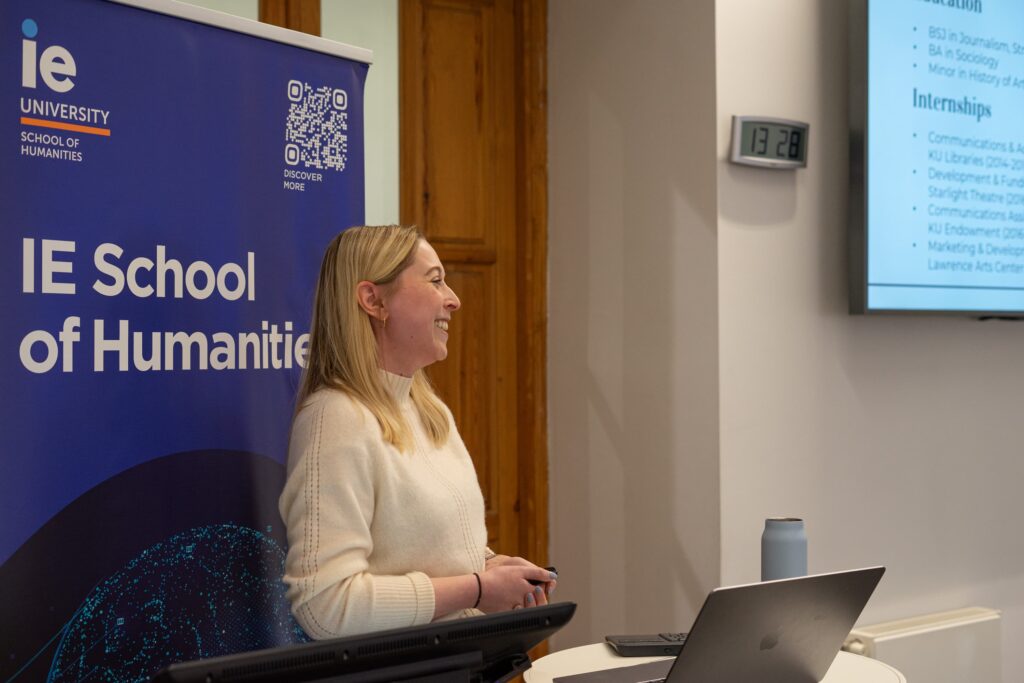
What does a grant writer do?
Grant writing combines a variety of skill sets and disciplines: communication, research, and strategy. The role focuses on translating social challenges into clear, credible proposals that public funders can support.
Where does impact happen?
Emily shared examples of funded projects across:

- Workforce development
- Healthcare
- Arts and culture
- Social services
In many cases, strong grant strategy is what allows these initiatives to move from idea to implementation.
Which skills matter most?
Humanities skills are not complementary, they are central:
- Writing that makes complexity understandable
- Research that builds credibility
- Critical thinking that connects needs, data, and outcomes
- Collaboration across institutions and stakeholders
Is there one path into this career?
No. Emily’s background spans Journalism, Strategic Communication, Sociology, and Art History, followed by roles in nonprofit communications, fundraising, consulting, and grants strategy. Interdisciplinary profiles are often an advantage in the social impact sector.

What challenges come with the work?
The field is evolving. Funding landscapes shift. Tools like AI are changing research and drafting. And impact-driven work carries emotional weight, making reflection and boundaries essential.
Grant writing goes beyong paperwork, it’s actually strategy
One of the most important insights from the session was that grant writing is not administrative work. It is decision-making work.

Grant writers help organizations answer fundamental questions:
- What problem are we really trying to solve?
- Who benefits, and how?
- What evidence supports this approach?
- How do we communicate impact in a way funders trust?
The answers to these questions often determine whether a project moves forward at all.
A career built from curiosity, not a straight line
Careers in social impact rarely follow linear paths, and that is not a weakness.
Emily’s journey showed students that moving across roles and disciplines can strengthen professional identity rather than dilute it.
Curiosity, adaptability, and the ability to connect ideas across contexts are critical in fields where problems are complex and constantly changing.

For humanities students, this reframes uncertainty. Not knowing exactly where you are headed does not mean you are behind. It often means you are building range.
Redefining what career success looks like
Another key takeaway was that meaningful careers do not have to fit traditional corporate models.
Grant writing and public funding roles can be:
- Project-based or independently structured
- Based in nonprofits, public institutions, or consulting
- International or remote
Success is measured less by hierarchy and more by impact, sustainability, and alignment with values.
Turning humanities skills into real-world impact
The humanities are often described in abstract terms. In careers like grant writing, their value becomes concrete.

Words unlock funding.
Research shapes decisions.
Critical thinking turns ideas into programs that affect real communities.
So by connecting students with professionals working across culture, communication, and social impact, initiatives like Careers in Context reflect how the IE School of Humanities supports students in exploring meaningful career paths, and in understanding how their skills translate beyond the classroom.
Sometimes innovation does not begin with a product or a startup. Sometimes it begins with a well-argued idea, and someone who knows how to make it heard.